


 Chinese

Hole Machining Basics: When to Use Rough Boring, Fine Boring and Countersinking
Holemaking is one of the most frequent operations in machining, and one of the least forgiving of a wrong call. Rough boring, fine boring and countersinking are often treated as interchangeable steps. They are not. Each has its own objective, its own position in the process, and its own tooling requirements — and confusing them is one of the most common reasons a bore drifts out of tolerance or a finishing tool fails early.
This guide sets out, in plain shop-floor terms, what each operation is actually for, when it earns its place in the routing, and where it should never be used.
| Operation | Primary objective | Where it cuts | What to control |
|---|---|---|---|
| Rough boring | Fast stock removal, truing the bore | Bore wall | Cycle time, rigidity, chip evacuation |
| Fine boring | Final diameter accuracy and surface finish | Bore wall | Tolerance, roundness, roughness |
| Countersinking | Counterbore, chamfer, spot-face at the mouth | Hole mouth (face / cone) | Flatness, angle, burr-free edges |
Standard boring range Ø6–850 mm | Custom tooling up to Ø3000 mm | Deep hole machining 10–14 × D
01Rough boring: clear the stock, build the base
The objective is not accuracy. It is removing the bulk of the allowance efficiently, and leaving a bore the finishing tool can trust.
When to use it
- Cored, cast or forged holes with heavy and uneven stock, where the bore must first be rounded and straightened.
- After drilling, when the diameter is still well oversize and needs rapid enlargement to leave a uniform finishing allowance.
- Long and deep holes, where straightness has to be corrected early so the finishing cut does not fluctuate and damage the fine boring tool.
- High-volume production, where metal removal rate and cycle time take priority.
Not for: holes taken straight to final size, or any bore carrying strict tolerance and surface-finish requirements.
A roughing pass typically leaves 0.1–0.3 mm per side for fine boring, adjusted to the workpiece material and the rigidity of the machine. Rough boring tools are judged on three things: rigidity, chip evacuation and impact resistance. The PAVO rough boring series is built to hold heavy feeds without chatter across steel, cast iron and aluminium, so stock comes off predictably rather than in a single risky pass.
Shop-floor note: do not chase surface finish at the roughing stage — but do keep the allowance uniform. An uneven allowance is what later shows up as dimensional drift and chatter marks in the finishing pass.
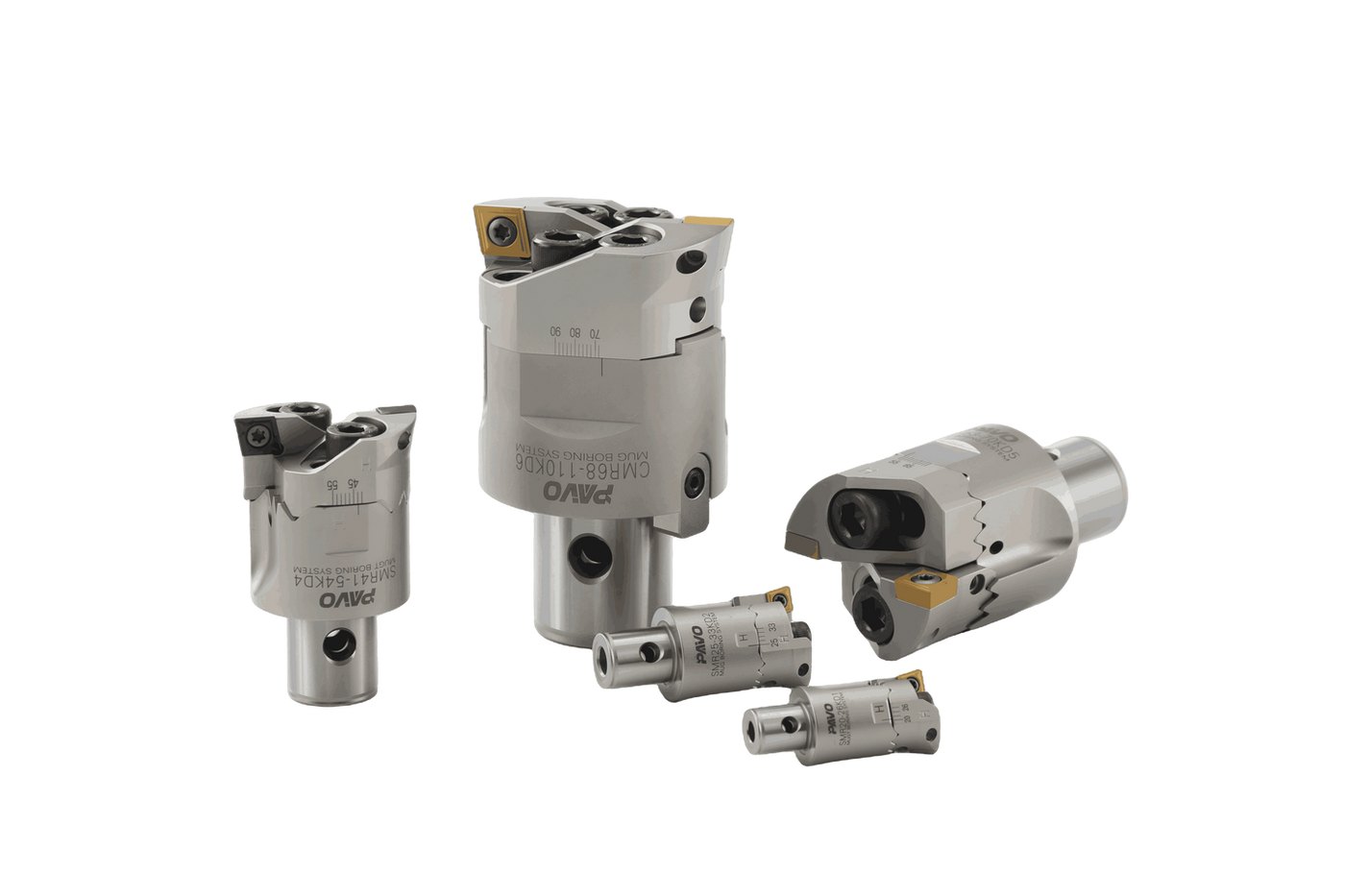
PAVO rough boring heads. Double-cutter and single-cutter designs with indexable inserts, scaled from small-diameter work up to large bores.
02Fine boring: hold the final size and finish
The last cut on the bore. It owns dimensional accuracy, roundness, cylindricity and the quality of the bore surface.
When to use it
- Mating bores with tight tolerances: bearing bores, valve sleeve bores, hydraulic cylinder bores, gear mounting bores.
- Drawings that specify high bore roughness, roundness or coaxiality.
- Volume production that needs consistent diameters and less manual inspection and rework.
- Correcting bore position ahead of honing or fine reaming.
Not for: heavy allowances or rough, uneven cast surfaces. A fine boring head under a heavy cut will chip and chatter, and the tolerance is gone before the pass is finished.
Stock is small and the cut is light, which places the demand squarely on the tool: micro-adjustment precision, balance and edge quality. PAVO micro-adjustable fine boring heads adjust on a clear, sensitive scale, so a diameter can be corrected on the machine in a single step and then held across a production run — which is what makes them the core tool in precision bore work.
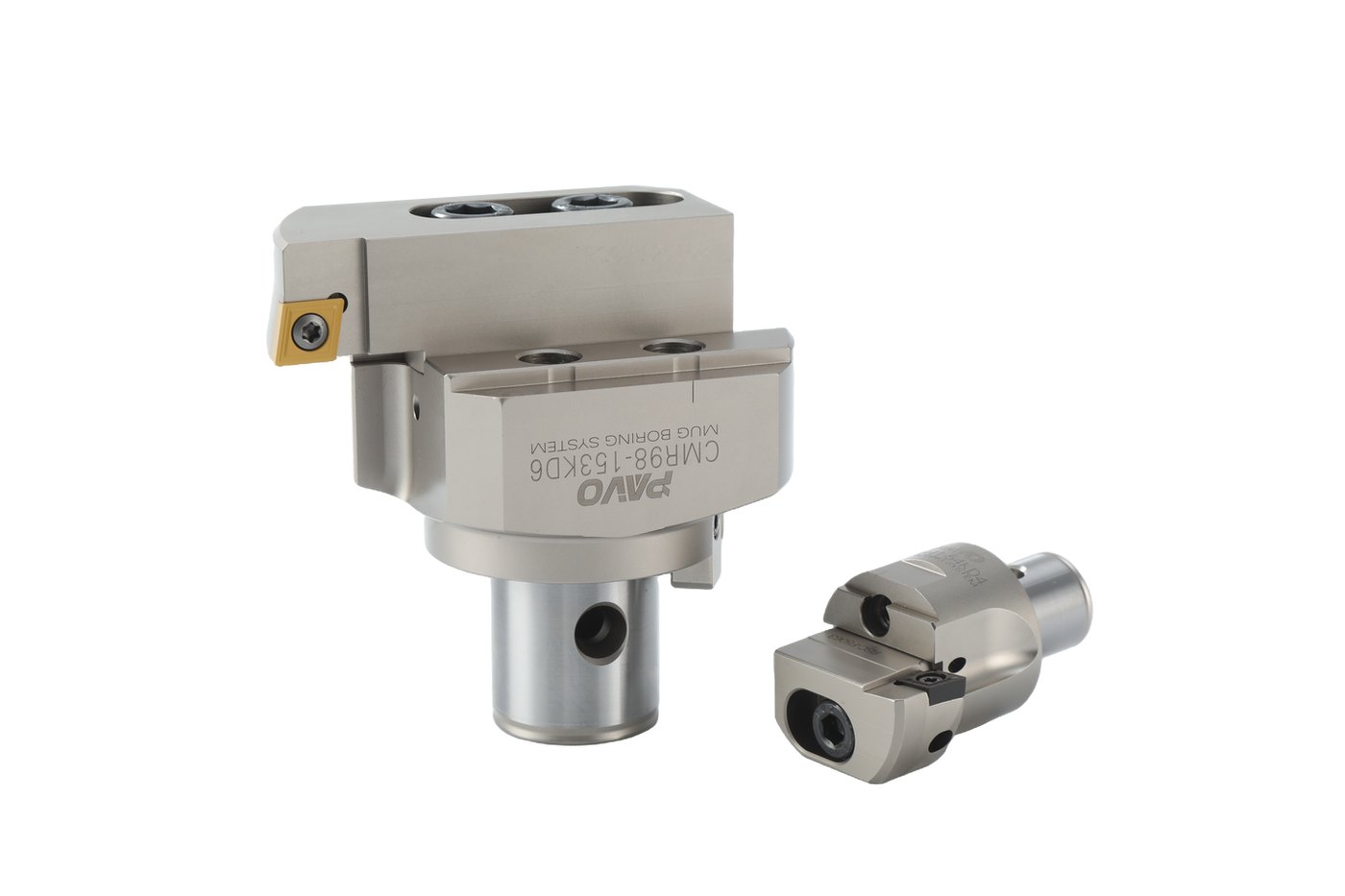
Micro-adjustable fine boring head — dial adjustment with direct reading of diameter change.
The fine boring range covers small through large bore diameters on a common adjustment principle.
03Countersinking: form the mouth of the hole
Frequently confused with boring. Boring works the bore wall; countersinking works the mouth of the hole — and is almost always a custom tool.
When to use it
- Counterbores for socket head screws and countersunk bolts, so the fastener head sits flush with, or below, the workpiece surface.
- Chamfering and deburring hole edges, so seals, bearings and O-rings are not damaged during assembly.
- Spot-facing and step faces at the hole mouth, so gaskets, flanges and covers seat flat.
- Cleaning up the mouth of cast, sheet-metal and valve-body holes, removing the burr and roll-over left by drilling.
Not for: machining the bore itself, or correcting straightness and internal dimensions. The geometry of a countersink tool does not support long internal cuts.
Countersinking is local, shallow work, so the priorities shift: a flat, mark-free face and a clean angle matter more than stock removal. PAVO builds countersink tooling to the required diameter, head angle and depth, forming the seat in a single pass — no second manual deburring step, and consistent seating across the batch.
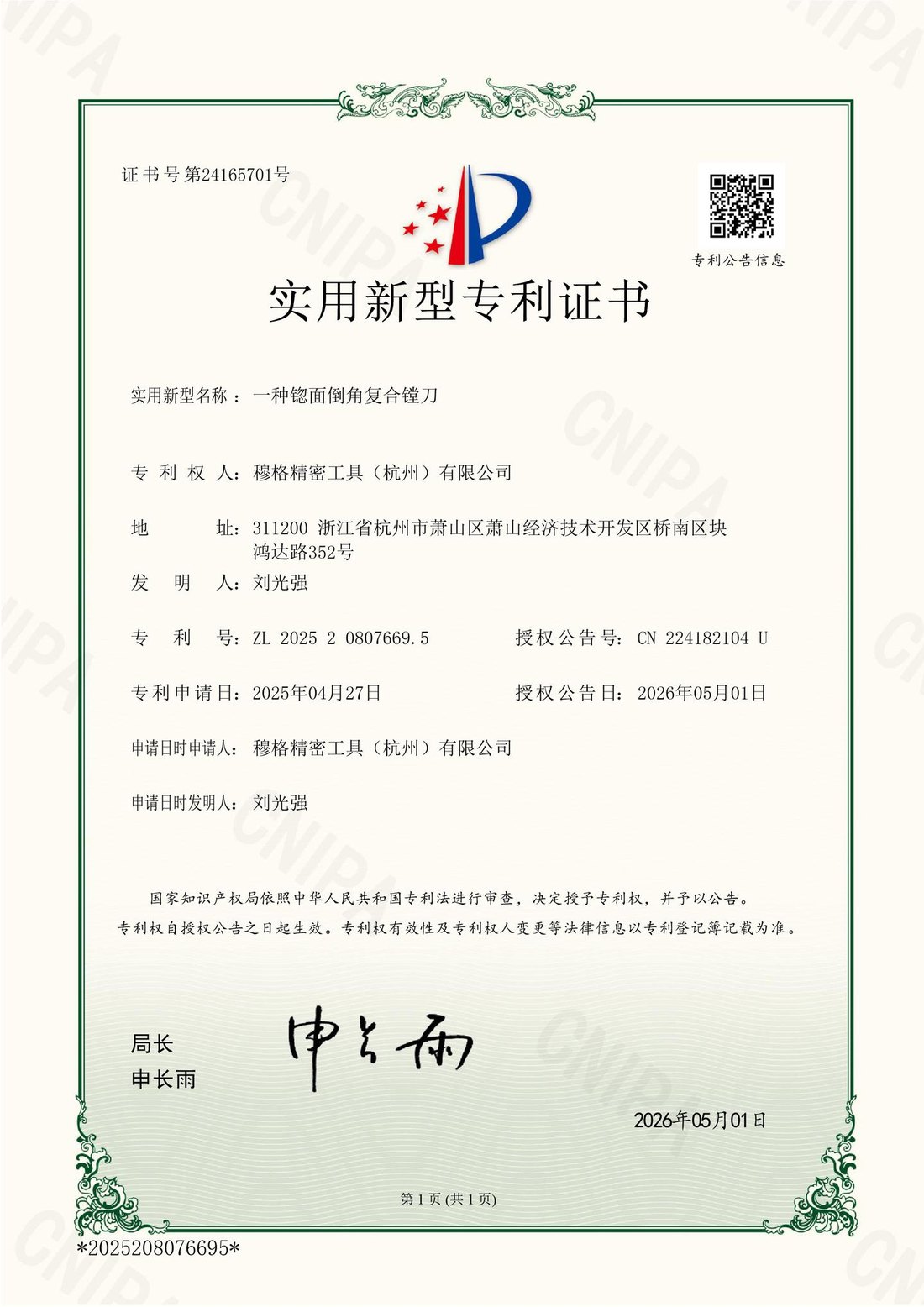
Patented in-house: PAVO’s composite countersink-and-chamfer boring tool is protected by Chinese utility model patent CN 224182104 U (ZL 2025 2 0807669.5).
Typical process routing
Cast blank → Rough boring → Fine boring
Pre-drilled hole → Rough boring → Fine boring → Countersink / chamfer / counterbore
04The short version
No holemaking process is good or bad in itself — only appropriate or not. Rough boring carries productivity, fine boring carries precision, countersinking forms the mouth. Used in the right sequence, the three balance output, yield and tool cost; used interchangeably, they quietly cost you all three.
Tell us about the bore, and we will tell you the tooling
Send us the workpiece material, machine type, diameter range and tolerance, and our engineers will come back with a tooling selection and starting cutting parameters. If you are fighting chatter, unstable diameters or marks on a countersink face, that is a conversation worth having early.
About PAVO Tools (Hangzhou) Co., Ltd. — A national high-tech enterprise, recognised as a “specialised and sophisticated” (zhuanjingtexin) SME and a Zhejiang Provincial Enterprise Research Institute. PAVO operates seven product systems — boring, milling, tool holders, drilling, custom tooling, carbide and accessories. Standard boring covers the full Ø6–850 mm range, custom tooling reaches Ø3000 mm, and deep hole machining runs to 10–14 × D. The company serves automotive, wind power and construction machinery customers, and exports to Italy, Japan and other markets.